
Learning to Walk in My Shoes
There is a saying that has followed me throughout different seasons of my life: “Never judge someone until you have walked a mile in their shoes.” It is one of those expressions we nod along to because it sounds wise, yet I wonder how often we truly allow it to shape the way we see other people.
If I am honest, parenting has been one of the greatest teachers of this lesson. It has quietly dismantled so many of my assumptions about people and replaced them with something far more valuable: compassion.
Before becoming a parent, it was easy to believe that every difficult situation had a straightforward answer. I thought consistency would solve every behavioural issue, good routines would prevent chaos, and enough love would naturally produce the outcomes we hoped for.
Then I became a mother, and I realised that children are not raised in textbooks. They are raised in real life, where illness interrupts carefully planned routines, exhaustion steals our patience, grief changes the atmosphere of a home, financial pressure weighs heavily on conversations, and children themselves carry personalities, experiences and emotions that cannot simply be managed away.
The older my children become, the more I have realised that every family is navigating circumstances that remain invisible to everyone else. We are all living stories that cannot be understood by watching a single chapter.
One Moment Is Never the Whole Story
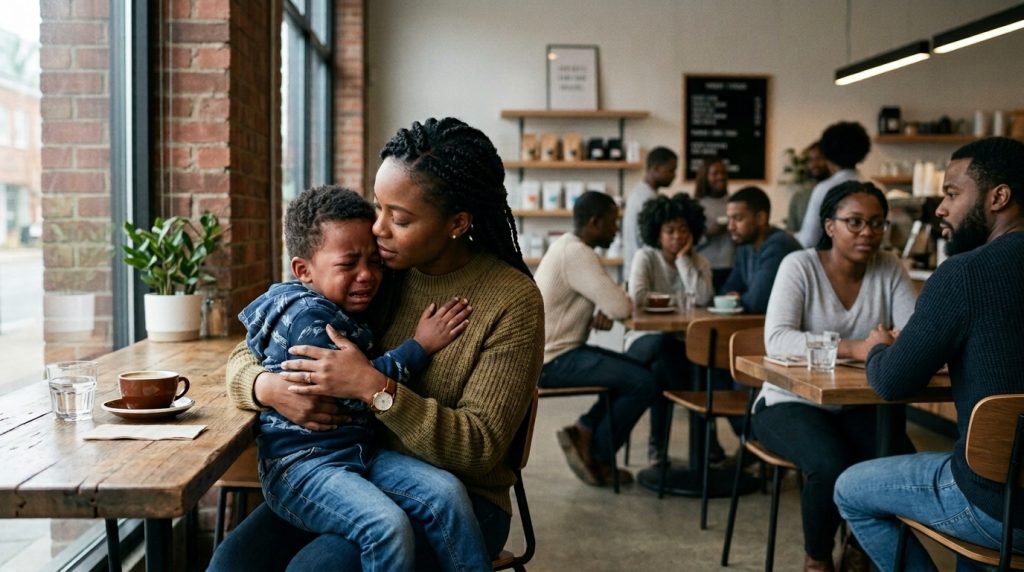
I remember sitting in a café one afternoon when a little boy became increasingly distressed. His mother did everything she could to calm him, speaking gently, offering reassurance and eventually holding him as he cried loudly enough for everyone in the room to notice.
Around her, the atmosphere began to change. Conversations paused. Heads turned. A few people exchanged knowing looks that carried far more judgement than kindness. One lady sighed loudly before shaking her head as though she had already reached her conclusion about the type of parent sitting a few tables away.
For a brief moment, I found myself observing exactly as everyone else was. Like everyone in that café, I only had the information that my eyes could see. I saw a distressed child. I saw a tired mother. I saw a situation that appeared difficult to manage.
What I could not see was the appointment they had attended only an hour earlier, where she had been told that her son would need further assessments because professionals believed he was displaying significant developmental differences. I could not see the sleepless nights she had spent researching conditions she had never imagined learning about.
I could not see the guilt she carried as she questioned every parenting decision she had ever made, wondering whether she had somehow failed him without realising it. I could not see the marriage that was quietly under strain because both parents were exhausted from carrying worries they struggled to put into words.
To everyone else, she was simply the mother with the disruptive child.
To herself, she was a woman desperately trying to hold her family together.
The truth is that both descriptions existed at the same time, but only one of them could be seen.
The Invisible Weight Parents Carry
I have often wondered how many parents we unknowingly reduce to a single moment. We watch a father lose his patience with his teenager in the supermarket without knowing that he has spent months trying to keep his son safe from negative influences that threaten to consume him.
We hear about a child who constantly misses school without knowing that anxiety has become so overwhelming that leaving the house feels like climbing a mountain. We quietly criticise the mother who appears distracted at the school gates, never considering that she may have spent the previous night sitting beside a hospital bed with an elderly parent before rushing home to prepare packed lunches.
The reality is that parenting never happens in isolation. It happens alongside marriages that are flourishing and marriages that are falling apart. It happens alongside financial hardship, bereavement, health concerns, workplace pressures and silent disappointments that children may never fully know about.
Every parent carries an invisible backpack filled with experiences, responsibilities and emotional burdens that shape the way they show up each day.
Perhaps that is why I have become increasingly cautious about making quick conclusions. Life has humbled me enough to know that certainty is often a luxury reserved for people standing at a distance.
When Life Teaches You Compassion
I think about the seasons in my own life when I have looked composed on the outside while feeling completely overwhelmed within. There have been days when I have smiled through conversations despite carrying worries that occupied every quiet moment of my mind.
There have been mornings when simply getting everyone dressed, fed and out of the house felt like an achievement, even though from the outside it looked entirely ordinary. Had someone observed only those few minutes, they may have formed opinions about me that bore little resemblance to the reality I was living.
Isn’t that true for all of us?
We are so much more than the moments people happen to witness.
Parenting has also taught me that comparison and judgement often grow in places where curiosity has disappeared. We assume that if someone parents differently from us, they must be parenting poorly.
If their child behaves differently from ours, then someone must be getting it wrong. Yet every child has a different temperament, every family has a different history, and every parent is responding to circumstances that outsiders rarely understand in full.

“Grace begins where assumptions end.“
It begins when we acknowledge that another parent’s story deserves the same compassion we hope people would extend to ours. It allows us to replace criticism with empathy because we recognise that we, too, have experienced seasons where we simply needed someone to believe we were doing our best.
Walking in Someone Else’s Shoes
As parents, we spend so much of our lives hoping people will see beyond our mistakes. We hope our children will one day understand that our boundaries were born out of love, not control.
We hope our friends will recognise that our absence sometimes reflects exhaustion rather than disinterest. We hope society will remember that raising children is one of the most emotionally demanding responsibilities a person can undertake, even when it appears effortless from a distance.
If we long for that kind of understanding ourselves, perhaps we should become intentional about extending it to others.
Learning to walk in someone else’s shoes does not mean we excuse harmful behaviour or pretend that every parenting decision is beyond question. Rather, it reminds us that humility should always accompany our opinions.
We can hold convictions without becoming condemning. We can offer support without assuming superiority. We can encourage without criticising.
There is a quiet wisdom that comes with recognising that every parent you meet is fighting battles you may never know about. Some are grieving the child they imagined they would have. Others are celebrating tiny victories that nobody else notices.
Some are desperately trying to break patterns that have existed in their families for generations, while others are learning how to parent without ever having experienced healthy parenting themselves.
These are not stories written across their foreheads.
They are carried quietly in their hearts.
Grace Before Judgement
Perhaps that is why grace remains one of the greatest gifts we can offer another parent. It costs us nothing, yet it has the power to lift a burden we may never fully understand.
Sometimes the kindest thing we can do is resist the temptation to become another voice that judges from a distance and instead become the person who chooses compassion before conclusions.
Because the truth is, none of us knows how we would walk until we have travelled the very road someone else has been asked to take. Until then, the wisest posture is not judgement, but grace.