
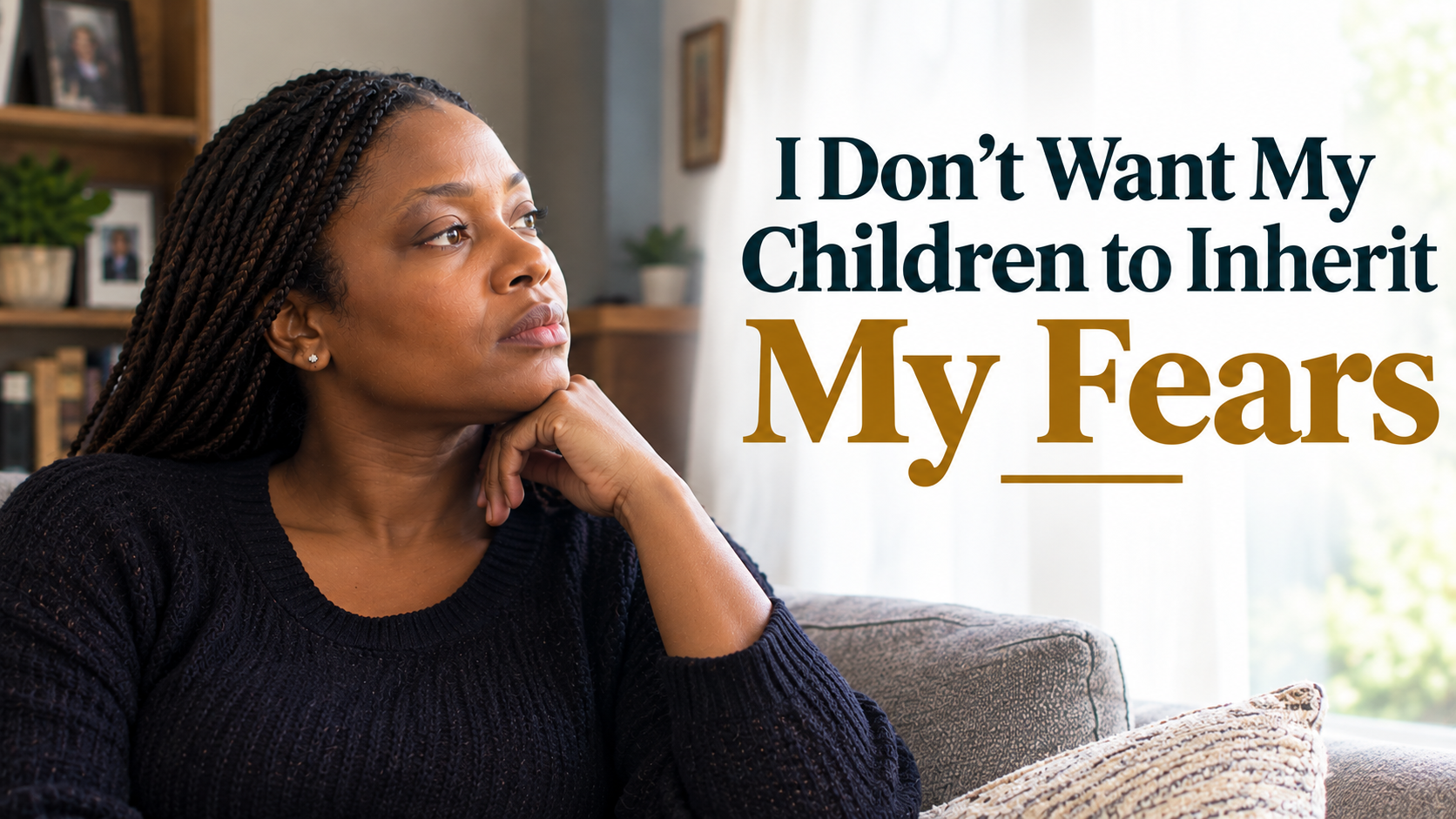
I Don’t Want My Children to Inherit My Fears
Giving our children the emotional freedom to experience life without carrying the fears that shaped us.
If you know me well, you will know that I do not like pets. Actually, let me correct that before somebody who knows me personally reads this and accuses me of watering down the truth: “I really do not like pets.“
I am not the person who walks into somebody’s house, sees a dog running towards me and immediately bends down, saying, “Awww, hello gorgeous!”
I am the person quietly calculating how quickly I can get to a chair, wondering whether the owner has noticed the mild panic on my face, while trying desperately to behave like a normal adult.
And yet, as much as I dislike pets, I have always been conscious of something when it comes to my children.
I do not want them to inherit my fear. I don’t want my reaction to become their reaction simply because they watched me long enough. I don’t want them to automatically believe that dogs are frightening because Mummy moves differently when one enters the room.

I don’t want them to miss the experience of loving an animal, stroking one, playing with one, or simply feeling comfortable around one because somewhere along the way I handed them a fear that belonged to me.
And actually, it is lovely to see that they love dogs. I watch them comfortably approach them, stroke them and enjoy being around them, and there is something quite beautiful about knowing that my fear did not become theirs.
For the avoidance of doubt, however, I still don’t like dogs. That has not changed. And, at this point, I don’t think it is going to.
The goal was never for me to suddenly become a dog lover. The goal was simply to make sure that my children had the freedom to decide for themselves.
That thought has made me think about parenting in a much wider sense, because pets are probably one of the easier examples.
What about the fears we pass down that are much harder to see?
Children Inherit More Than Our Features
We often talk about the things our children inherit from us with amusement.
“She has your smile.”
“She definitely gets that stubbornness from you.”
“That is exactly how you used to behave.”
We notice the eyes, the mannerisms, the humour, the temperament and even the strange little habits that somehow travel through generations.
But children can inherit things that cannot be seen in a photograph. They can inherit our relationship with failure.
- Our anxiety about money.
- Our fear of rejection.
- Our need for approval.
- Our reluctance to take risks.
- Our distrust of people.
- Our beliefs about relationships.
- Our fear of being embarrassed.
- Our tendency to shrink ourselves when we enter certain rooms.
Sometimes we don’t even have to explicitly teach these things. Children are extraordinary observers. They watch how we respond to life, and slowly those responses can become part of their understanding of how life works.
A parent does not necessarily have to say, “Taking risks is dangerous,” for a child to learn it. Perhaps they simply watch us repeatedly choose safety because uncertainty frightens us.
We don’t have to tell them, “People’s opinions should determine your decisions.” They may learn that by watching how often we change ourselves to keep other people comfortable.
We don’t have to say, “Failure is shameful.” They may simply notice how devastated we become when something doesn’t work out, or how much importance we attach to achievement.
And perhaps one of the most uncomfortable parts of parenting is realising that our children are not only listening to what we teach them.
They are watching what we fear.
Some of Our Fears Once Kept Us Safe
I think it is important to say that many of the fears we carry did not appear from nowhere.
Some were formed in childhood. Some came through painful experiences. Some came from rejection, instability, financial hardship, betrayal or environments where making a mistake carried consequences that felt enormous.
- Perhaps you grew up hearing, “What will people say?”
- Perhaps money was always scarce, so even now spending can make you anxious despite being financially secure.
- Perhaps you were taught that success meant choosing the safest possible path: get the qualification, find the stable job, don’t take unnecessary risks.
- Perhaps you watched relationships break down and quietly promised yourself that you would never allow anyone enough access to hurt you like that.
- Perhaps failure was not treated as part of learning in your childhood. It was embarrassing. It attracted criticism. It made you feel as though you had disappointed somebody.
So you learned. You adapted. You protected yourself.
The difficulty comes when the protection we once needed becomes the limitation we accidentally hand to our children. Because something can have been necessary for our survival and still not be necessary for theirs.
“Be Careful” Can Become a Way of Life
As parents, we naturally want to protect our children.
I have said “be careful” more times than I could ever count. Sometimes, before my children have even done anything remotely dangerous. It is almost an automatic parental response.
“Mum, I’m going…”
“Okay, just be careful.”
They could probably tell me they were going upstairs to get a jumper, and somewhere inside me would still want to remind them to proceed with caution.
But there is another kind of “be careful” that I have become increasingly aware of.
- Be careful with your dreams.
- Be careful who you trust.
- Be careful about trying something different.
- Be careful because you might fail.
- Be careful because people might laugh.
- Be careful because that career isn’t secure.
- Be careful because relationships hurt.
- Be careful because money disappears.
- Be careful because life taught me that this is dangerous.
Protection is part of parenting, but I don’t want caution to become the soundtrack of my children’s lives.
There will be times when wisdom requires caution, of course. But there will also be times when growth requires courage, and I want my children to know the difference.
Their Story Does Not Have to Repeat Mine
This is perhaps one of the greatest freedoms we can give our children: permission to experience life differently from us.
If I have experienced rejection, they do not have to enter every relationship expecting abandonment.
If I have struggled financially, they do not have to develop an unhealthy fear of money.
If I have failed at something, they do not have to avoid trying it.
If somebody’s opinion once wounded me, they do not have to spend their lives seeking approval.
If I have been hurt in love, they are still allowed to believe that healthy love exists.
And yes, if I don’t like pets, they are allowed to absolutely adore them. Their lives are not meant to be replicas of mine.
That sounds obvious, but I think parenting sometimes challenges us precisely here. We have lived longer. We know what can go wrong.
We have experienced consequences they cannot yet imagine, and there is a temptation to believe that because something happened to us, we can prevent pain by teaching them to avoid anything remotely similar.
But sometimes our children need the opportunity to discover that the outcome can be different.
They may trust someone and experience beautiful friendship. They may take the risk and succeed. They may take the risk and fail spectacularly, then discover that failure did not destroy them.

They may choose the unconventional path and build a life we could never have imagined for them. They may love differently, dream bigger, travel further, speak louder, ask for more and tolerate less.
And perhaps that is not something for us to fear. Perhaps that is part of the point.
I Want Them to Know That Failure Is Survivable
Failure is one fear I particularly don’t want my children to inherit.
Of course, I want them to work hard. I want them to understand responsibility, commitment and the importance of giving their best. But I never want achievement to become so closely connected to their identity that they become terrified of getting something wrong.
I want them to apply for things they are not certain they will get. I want them to walk into rooms where they feel slightly underqualified. I want them to try something and discover they are terrible at it.
I want them to change their minds. I want them to start again. I want them to understand that sometimes the answer will be no, and the no will hurt, but life will continue.
Because imagine how much freedom there is in raising a child who knows that “If this doesn’t work, I will still be okay.” That is a powerful thing to carry into adulthood.
I Want Them to Be Open to Different Opinions.
There is another inheritance I would quite happily interrupt: living according to what other people might think.
Many of us were raised within cultures, families or communities where reputation mattered enormously. Decisions were not always simply about what was right for you; there was an invisible audience to consider.
- What will people think?
- What will the family say?
- How will this look?
There is value in community, accountability and considering how our choices affect others. But there is a difference between living responsibly and living imprisoned by other people’s opinions.
I don’t want my children to become adults who need permission from an imaginary committee before making decisions about their own lives.
I want them to be kind without being controlled. Respectful without disappearing. Considerate without constantly abandoning themselves. I want them to listen to wise counsel while still learning to trust the voice developing within them.
Because there will always be someone with an opinion about the way they live. And if they build their lives around pleasing everybody, eventually they may discover that everybody is happy except them.
Sometimes Parenting Means Examining Ourselves
I am learning that raising emotionally free children requires a certain amount of honesty from us as parents.
Sometimes I have to ask myself: “Am I warning them because there is genuinely something they need to know, or because I am frightened?” “Am I protecting them, or am I projecting onto them?” “Is this wisdom I am passing down, or is this an unresolved fear?”
Those questions are not always comfortable. Because parenting has a strange way of bringing us face-to-face with ourselves.

Our children reach ages, situations and milestones that remind us of who we were at their age. Suddenly our memories, insecurities and experiences enter the room with us. And sometimes we have to consciously decide that what happened to us will inform our parenting without controlling it.
There is a difference. Our experiences can give us wisdom without becoming our children’s boundaries.
Maybe This Is Part of Breaking Cycles
We often talk about breaking generational cycles in relation to the big things, but perhaps cycle-breaking also happens in these quieter moments.
It happens when a parent who grew up terrified of failure says, “Give it a go.”
When someone who never felt heard sits and listens to their child.
When a parent who struggled with money teaches financial wisdom without creating financial fear.
When someone who experienced rejection teaches their child that rejection is painful but not defining.
When a parent who spent years worrying about what everybody thought raises a child who knows how to make thoughtful decisions without needing everybody’s approval.
And perhaps it even happens when a mother who would quite happily live the rest of her life without voluntarily interacting with a dog makes sure her children understand that her fear belongs to her.
There is something beautiful about being able to say:
“This is something I struggle with, but you don’t have to.”
They Are Allowed to Be Freer Than Me
Ultimately, I think that is what I want. I want my children to be freer than me. Not reckless. Not naive. Not protected from every reality of life.
Just freer…
- Free enough to try.
- Free enough to fail.
- Free enough to love.
- Free enough to walk away.
- Free enough to change direction.
- Free enough to dream beyond what feels familiar.
- Free enough to disappoint people when staying true to themselves requires it.
- Free enough to recognise fear without automatically obeying it.
I know I will inevitably pass parts of myself down to my children. Some intentionally, others without even realising it. That is part of being human and part of being a parent.
But I hope I remain conscious enough to recognise when something belongs to my history rather than their future.
Because my job is not to hand them a map with every place that hurt me carefully circled in red and tell them never to go there.
My job is to give them wisdom, values, roots and somewhere safe to return to, then gradually allow them to make their own way through the world.
And when I look at something as simple as their love of dogs, I realise that perhaps I am already seeing a little bit of that freedom.
They love them. They are comfortable around them. They don’t carry the same fear that I do. And I genuinely love that for them.
I still don’t like dogs, though; let’s not get carried away. That is not going to change, but perhaps that is exactly the point.
Our children do not need us to conquer every fear before they can be free from it. Sometimes we simply have to become aware enough of what belongs to us to make sure we don’t hand it to them.
Maybe they will go places I was too frightened to go, attempt things I talked myself out of, love with an openness I had to learn much later, stand confidently in rooms where I once questioned whether I belonged.
And if they do, I hope I have the wisdom not to pull them backwards simply because I am still learning how to move forwards.
They can inherit my love, my values, my lessons and hopefully some of my strength. But they do not have to inherit my fears.
This was such a good piece👍 Perhaps we might also subconsciously make our children like what we like, maybe not just our fears say maybe food, Sense of style, etc. on a lighter note I Love love dogs so much..😄 my parents loved dogs, and I made my children love them also without even realizing it. I guess as parents, we are their mirror. They watch us!!!