
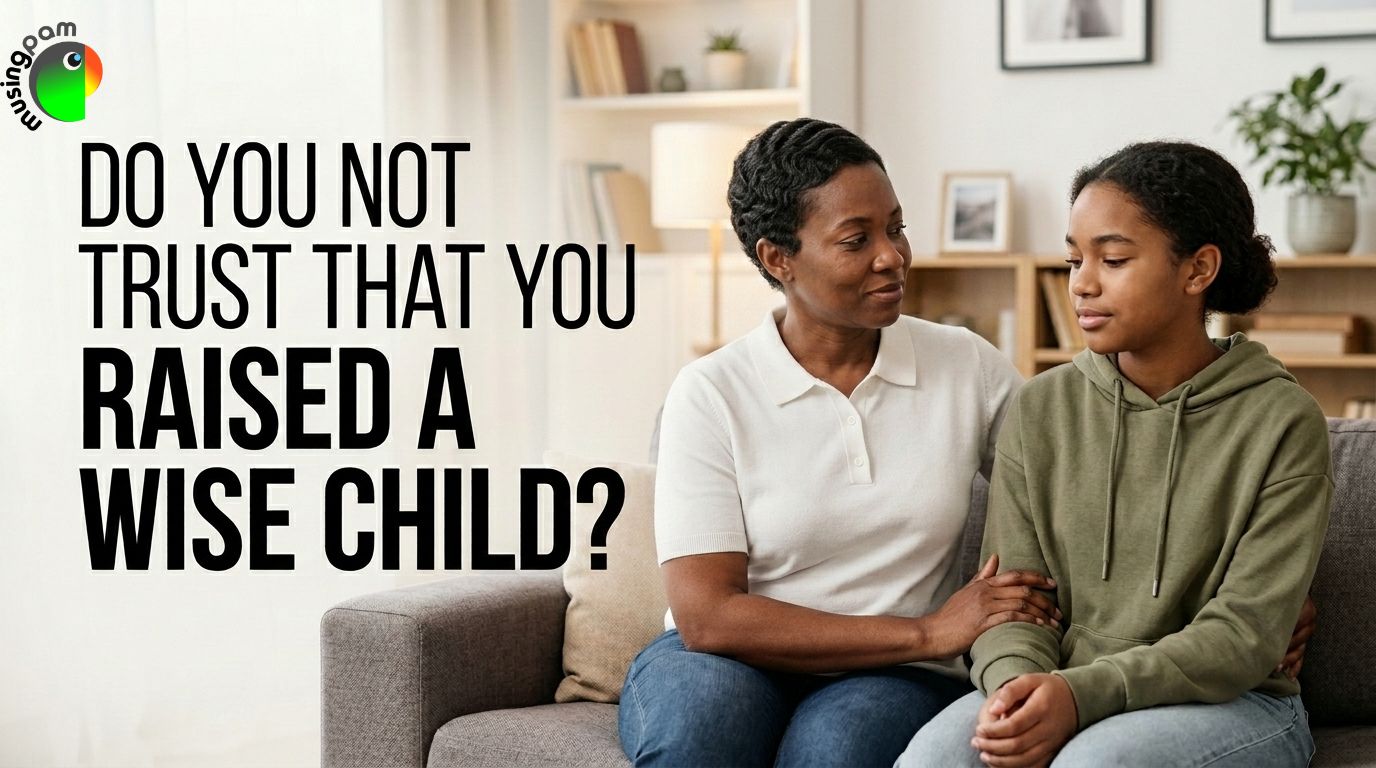
Do You Not Trust That You Raised a Wise Child?
Sometimes the greatest lessons in parenting come from the very people we think we are teaching.
A Familiar Parenting Battle
Recently, I had a massive disagreement with my fifteen-year-old daughter. It was one of those moments that many parents will recognise immediately; a conversation that started about one thing but eventually became about something much deeper.
What began as a discussion about responsibilities at home quickly escalated into frustration on both sides, and before long, we were no longer communicating as clearly as we should have been.
At the heart of the disagreement was a familiar parenting struggle. For several weeks, I had found myself repeatedly reminding her about the same things. Keeping her room tidy. Cleaning up after herself. Leaving the bathroom in a reasonable state after using it.
None of these expectations was new, and none of them was unreasonable. The problem was not the tasks themselves. The problem was that I felt as though I was constantly having the same conversation.
During the disagreement, my daughter suddenly stopped and said something that caught me off guard.
“Mum, why have you become so aggie recently? Things that you would usually tell me off for gently, you’ve been shouting about.”

If I am honest, my immediate reaction was defensive.
I reminded her that this was exactly the issue. I explained that the frustration she was seeing was not about one towel left on the floor, one messy bedroom, or one untidy bathroom. It was the accumulation of countless reminders that seemed to disappear into thin air.
What she experienced as me becoming stricter, I experienced as the exhaustion that comes from repeating myself over and over again and feeling as though nothing is changing.
As parents, we often carry the emotional weight of the previous twenty conversations, while our children are responding only to the one happening in front of them.
That thought stayed with me long after the argument.
Although I still believed my frustration was understandable, I could also see that my daughter was trying to tell me something important. She was not necessarily challenging the expectation. She was challenging the way we were communicating. In her eyes, something had shifted, and she was brave enough to say it.
Enter the Family Mediator
Before either of us had a chance to properly process what had happened, my twelve-year-old daughter decided she had seen enough.
She approached me and announced that we needed a meeting.
Not a conversation.
Not a chat.
A meeting.
To resolve the conflict.
I looked at her with a mixture of amusement and disbelief.
“Why am I asking a child to resolve a conflict?” I asked.
Without hesitation, she looked directly at me and replied, “Do you not trust that you raised a wise child?”
I genuinely did not know what to say.
Part of me wanted to laugh. Part of me wanted to challenge her confidence. Another part of me realised she had effectively cornered me with logic that was difficult to argue against.

After all, how could I spend years teaching my children to think critically, communicate confidently and contribute meaningfully to difficult conversations, only to dismiss them when they actually did it?
So the meeting went ahead.
A Front Row Seat in Court
And honestly, it felt a little bit like being in court.
My youngest daughter somehow managed to take on the role of mediator with a level of confidence that was both impressive and slightly concerning. She invited each of us to explain our perspective, challenged us when our explanations did not quite add up, and asked questions that encouraged us to consider how the other person might be feeling.
What struck me most was that she was not interested in deciding who was right.
She was interested in helping us understand one another.
As I watched her facilitate the conversation, I found myself becoming less focused on the original disagreement and more focused on what was unfolding in front of me. Here was a twelve-year-old confidently navigating conflict, creating space for both people to speak, and gently challenging us to listen to one another more carefully.
In that moment, I realised I was witnessing something every parent hopes for but rarely gets to see so clearly.
The Lessons We Hope They Learn
We spend so much time teaching our children values without knowing whether they are truly taking root. We encourage empathy, kindness, communication, resilience, accountability and respect, often wondering whether our words are making any difference at all. Much of parenting feels like planting seeds and waiting patiently, sometimes for years, to see whether anything grows.
Then every so often, life gives you a glimpse.
A glimpse that reminds you the lessons have not been wasted.
My fifteen-year-old daughter felt secure enough in our relationship to tell me when she felt hurt by my approach. My twelve-year-old daughter felt confident enough to step into an uncomfortable situation and help bring restoration. Neither child was trying to win. Neither child was trying to prove a point. Both were trying to move us towards understanding.
That is emotional intelligence.
That is courage.
And perhaps most importantly, that is connection.

The Contract
Just when I thought the meeting was coming to an end, our mediator informed us that we needed a contract.
Apparently, no official conflict resolution process is complete without one.
I wish I could tell you that this was a casual verbal agreement, but it was not. There was discussion. There was negotiation. There were expectations. There were commitments. There may even have been clauses.
As the conversation unfolded, something beautiful happened.
My fifteen-year-old daughter acknowledged that she needed to do better. She recognised that part of the conflict stemmed from not consistently following through on the responsibilities that had been discussed many times before. She accepted that if she wanted trust and freedom, she also needed to demonstrate responsibility.
But what surprised me was what happened next.
My twelve-year-old mediator also reflected on her own role. She acknowledged that she, too, had areas she could improve on and that maintaining peace within a home requires effort from everyone, not just one person. She recognised that conflict is rarely solved by simply pointing fingers at somebody else.
Together, they agreed that they both had things they needed to work on.
They agreed to be more mindful.
They agreed to listen more carefully.
They agreed to take greater responsibility for the things within their control.
And then, like two junior solicitors finalising a settlement, they signed their contract.
I sat there watching the whole thing unfold and found myself trying not to laugh while simultaneously feeling incredibly proud.
Because the contract itself was not really the point.
The point was ownership.
The point was accountability.
The point was to watch two young people reflect on their own behaviour rather than focus entirely on somebody else’s.
Conflict Is Not the Enemy
The disagreement itself was not particularly remarkable. Families disagree every day. Parents and teenagers will always find themselves navigating tension as children grow, test boundaries and develop their own voices.
Conflict is not necessarily a sign that something is wrong. More often, it is evidence that relationships are evolving and that everyone involved is learning how to communicate through different seasons of life.
What matters is what happens afterwards.
Do we repair?
Do we listen?
Do we learn?
Do we allow ourselves to be challenged, even when the challenge comes from someone younger than us?
Healthy families are not families that never argue. Healthy families are families that find their way back to one another after an argument. They are families where people feel safe enough to express their feelings and secure enough to know that disagreement does not threaten belonging.

Low-Key Proud
By the end of our family meeting, the expectations had not changed. Bedrooms still need tidying. Bathrooms still needed cleaning. Responsibilities still mattered.
But something else mattered too.
We had listened to one another.
We had heard one another.
And somewhere in the middle of all of it, I found myself feeling unexpectedly proud.
Not because my children were perfect.
Not because I was perfect.
But because I was watching two young girls become thoughtful, emotionally aware young people who were willing to engage in difficult conversations rather than avoid them.
As parents, we often measure success through outcomes we can see: good grades, achievements, milestones and accomplishments. Yet some of the most meaningful victories happen quietly within the walls of our homes.
They happen in moments of honesty, accountability, forgiveness and repair. They happen when our children begin to demonstrate the very qualities we have spent years trying to nurture.
So yes, I walked into that meeting slightly annoyed.
But I walked out low-key proud.
Because for a brief moment, I got to witness something every parent longs for.
I got to see that perhaps, just perhaps, the lessons are sticking.
And somewhere in my house, there is probably still a signed conflict resolution contract to prove it.