
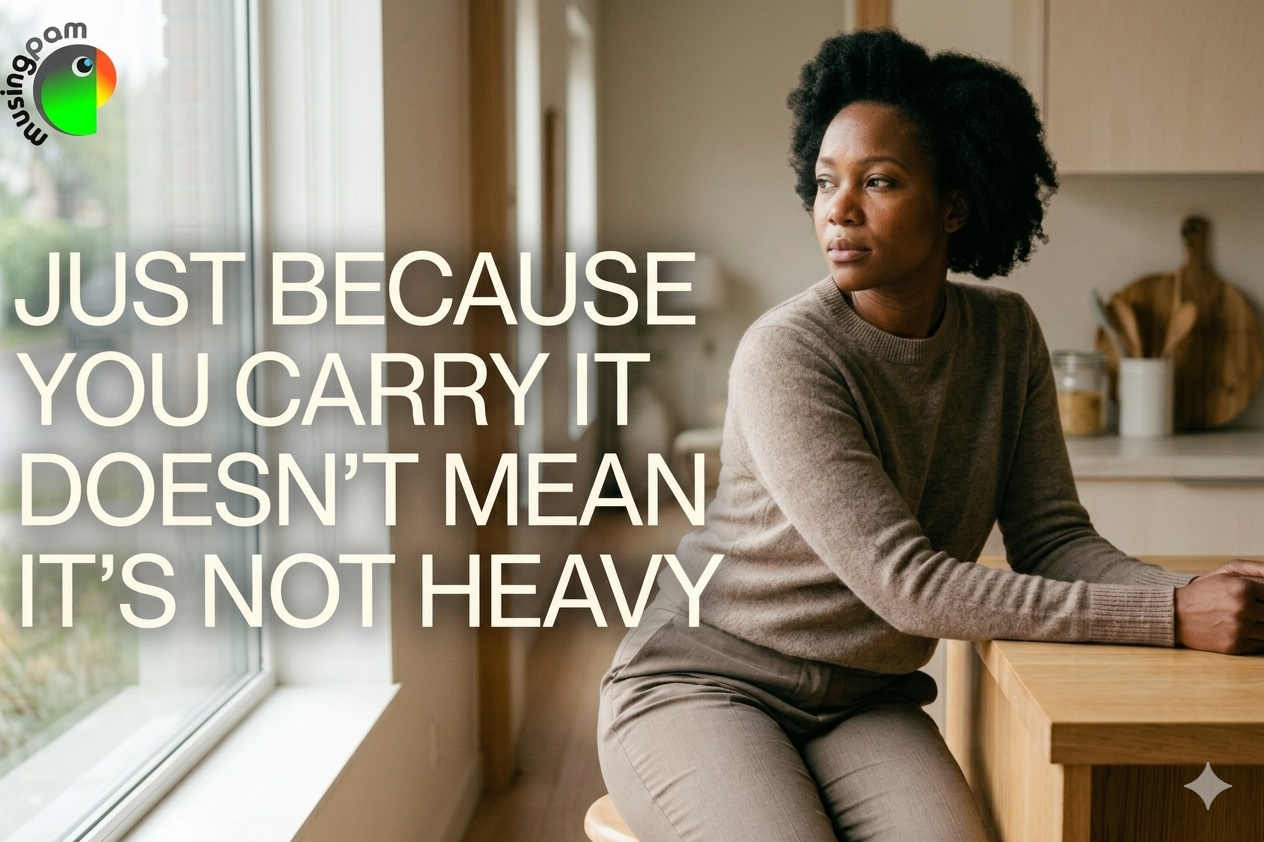
Just Because You Carry It Doesn’t Mean It’s Not Heavy
There is a misconception that I think many parents quietly live under, and it is the belief that if we are still standing, still functioning, and still showing up for everyone around us, then whatever we are carrying cannot possibly be that difficult.
The reality is quite different.
Many of us have become so skilled at carrying heavy things that people no longer recognise the weight. We attend the school meetings, manage the household, navigate work deadlines, support friends and family members, pay the bills, remember birthdays, organise appointments, and somehow keep life moving forward.
From the outside, it can look as though we are coping effortlessly, but often what people are witnessing is not ease; it is endurance.
Parenting, in particular, has a way of stretching us in ways that few other experiences can. It calls us to give constantly, often without immediate reward, while simultaneously carrying concerns that rarely leave our minds. Even in moments when our children are asleep, many of us are still thinking about them.
We are wondering whether they are happy, whether they are coping, whether we handled a difficult conversation well, whether we are preparing them adequately for a world that is not always kind, and whether we are somehow getting this whole parenting thing right.
The emotional load of parenting is rarely visible, but that does not make it any less real.

The Day My Daughter Found Me Crying
I was reminded of this recently during a moment that caught me completely off guard.
It had been one of those seasons where life felt particularly demanding. Nothing catastrophic had happened, and there was no single event I could point to as the source of my emotions. Instead, it was the accumulation of many different responsibilities, expectations, worries and pressures that had gradually built up over time.
Like water filling a glass drop by drop, I had continued pouring into everyone around me without fully noticing how close I was to overflowing.
That day, after trying to push through as I normally would, I found myself sitting quietly and crying.
The tears were not dramatic, nor were they born out of hopelessness. They were simply the release of emotions that I had been carrying for longer than I realised. I was tired from holding everything together, tired from making decisions, tired from constantly thinking ahead, and tired from carrying responsibilities that seemed to follow me into every room I entered.
As I sat there gathering my thoughts, one of my daughters walked in unexpectedly.
The moment she saw me, her face changed. Children have an incredible ability to notice the things we believe we are hiding.
She looked at me for a second before asking softly, “Mummy, are you okay?”
For a brief moment, I considered doing what many parents instinctively do. I thought about wiping away the tears quickly, forcing a smile, and reassuring her that everything was fine. I thought about stepping back into the role of the strong parent who always has the answers and never appears shaken.
Instead, I chose honesty.
I told her that I was okay, but that I was feeling overwhelmed.
What happened next was both simple and profound.
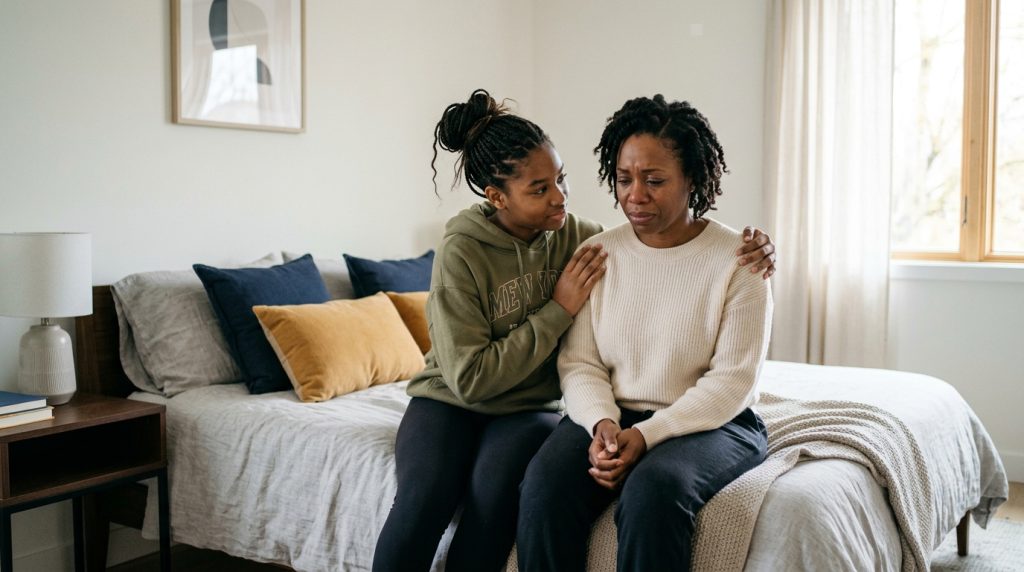
She came over, sat beside me, and wrapped her arms around me. There was no attempt to solve my problems, no profound wisdom, and no grand gesture. She simply sat with me in that moment, offering the kind of comfort that children often give so naturally. For a few minutes, neither of us needed to say very much.
Long after the tears had dried, I found myself reflecting on that interaction because it challenged something I think many of us have come to believe about parenting.
What Are We Teaching Our Children About Strength?
Somewhere along the way, many parents have accepted the idea that being strong means never letting our children see us struggle. We convince ourselves that vulnerability will make them feel unsafe, that admitting we are overwhelmed will somehow diminish us in their eyes, and that our role is to appear unaffected regardless of what is happening internally.
Yet I am not convinced that this is what our children need from us.
Of course, there is a difference between sharing appropriately and placing adult burdens on children. Our children should never become responsible for managing our emotions or carrying worries that belong to us. However, there is something deeply valuable about allowing our children to see that strength and vulnerability can coexist.
When our children see us acknowledge difficult emotions in healthy ways, they learn that emotions are not something to fear. They learn that feeling overwhelmed is not a sign of failure. They learn that tears are not evidence that someone is falling apart, but sometimes evidence that they have been carrying a lot for a very long time.
Most importantly, they learn that resilience is not about pretending everything is fine.
True resilience is about facing reality honestly while continuing to move forward.
The Lesson Children Learn From Watching Us
As parents, we often spend so much time teaching our children through words that we forget how much they learn from observation. They watch how we respond to disappointment. They watch how we navigate conflict. They watch how we recover from setbacks. They watch how we speak to ourselves during difficult seasons. They watch how we carry stress, uncertainty and pain.
The lesson my daughter learned that day was not that her mother was weak.
The lesson was that her mother was human.
And perhaps that is a lesson our children need more than we realise.
I do not want my daughters to grow into women who believe they must suppress every difficult emotion to appear strong. I do not want them to feel ashamed when life feels heavy, nor do I want them to measure their worth by how much suffering they can silently endure.
Instead, I want them to understand that there will be seasons when they feel stretched, tired, disappointed or overwhelmed, and that experiencing those emotions does not make them incapable. It simply makes them human.
I want them to know that asking for support is not a weakness. I want them to know that rest is not laziness. I want them to know that vulnerability, when expressed in healthy ways, is not something to be hidden from but something that can deepen connection and understanding.

The Burdens We Were Never Meant to Carry Alone
Most of all, I want my daughters to know that God never expected them to carry life’s burdens alone.
One of the greatest comforts of faith is the reminder that we do not have to pretend with God. We do not have to convince Him that we are coping when we are exhausted, nor do we have to hide our fears, frustrations or tears.
He is not impressed by our ability to carry everything ourselves. In fact, Scripture repeatedly invites us to bring our burdens to Him because He understands that there are some weights we were never meant to bear alone.
As parents, we often find ourselves carrying the emotional well-being of our children, worrying about their friendships, their confidence, their future, their choices and their safety. We carry hopes that they may never even be aware of and concerns that we rarely speak aloud.
While these responsibilities come from a place of love, they can become incredibly heavy when we forget that our children ultimately belong to God before they belong to us.
There is freedom in remembering that we are called to be faithful parents, not perfect ones.
A Gentle Reminder for the Tired Parent
Perhaps that is why this phrase resonates so deeply with me.
Just because you carry it does not mean it is not heavy.
You may be carrying your family through a difficult season. You may be carrying financial pressures, health concerns, work demands or emotional burdens that nobody else sees. You may be carrying grief, disappointment, uncertainty or the exhaustion that comes from constantly being the person everyone depends on.
The fact that you are still standing does not mean the load is light.
It simply means you have been strong enough to keep going.
And if today you are feeling the weight of everything you have been carrying, perhaps the invitation is not to try harder or carry more. Perhaps the invitation is simply to acknowledge the weight, extend yourself some grace, and remember that even the strongest shoulders were never designed to carry every burden alone.
Because carrying something well does not make it any less heavy.
It simply reveals the quiet strength it has taken to hold it for so long.