
The Weight of Other People’s Choices
Recently, I have been thinking about how much energy we spend evaluating other people’s choices.
Not necessarily judging them, although sometimes we do that too, but constantly measuring, comparing, analysing, and deciding whether we agree with the way someone else has chosen to live their life.
As parents, we can find this particularly difficult because few areas of life attract more opinions than how we raise our children. Everyone seems to have a view on what is best, whether it is education, discipline, screen time, friendships, faith, routines, extracurricular activities, or the countless other decisions that make up family life.
The challenge is that when we are exposed to so many perspectives, it becomes easy to assume that there must be one correct way to do things and that our job is to find it.
However, the older I get, the more I am convinced that much of life does not work that way.

Different Roads, Different Outcomes
Some children thrive in highly structured environments where expectations are clear and routines are predictable. Others flourish when given greater flexibility and space to explore.
Some families build connections through shared adventures and experiences, while others create deep bonds through quiet evenings at home.
Some parents are naturally expressive and affectionate, while others communicate love through consistency, reliability, and presence.
What becomes apparent over time is that people can arrive at healthy outcomes through very different routes.
Yet despite knowing this, many of us continue to compare our lives against standards that were never designed for us.
The Comparison Trap
Social media has undoubtedly amplified this tendency. We are constantly exposed to carefully curated snapshots of other people’s lives, often without any meaningful understanding of the context behind them. We see the outcome without seeing the sacrifices, the values, the challenges, or the circumstances that shaped the decisions leading to that outcome.
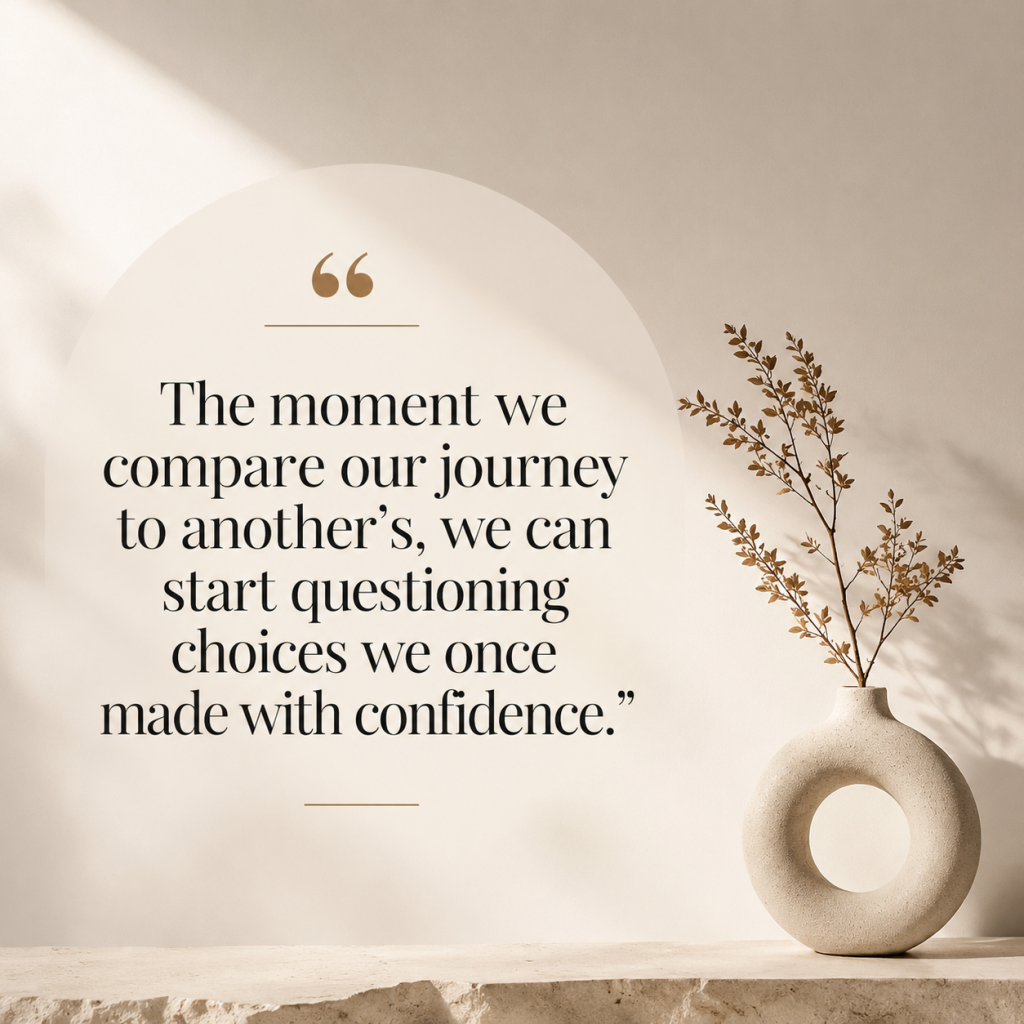
As a result, we sometimes find ourselves questioning choices that we were perfectly comfortable with until we saw somebody else doing something different.
I have noticed this not only in parenting but in almost every area of life.
We compare careers.
We compare relationships.
We compare finances.
We compare lifestyles.
We compare how people spend their time, raise their children, practise their faith, and pursue their goals.
Somewhere along the way, comparison quietly convinces us that “different” must mean better.
Yet different simply means different.
Building a Life That Fits You
One of the most valuable lessons I hope to pass on to my children is that they do not need to build their lives around somebody else’s blueprint. There is wisdom in learning from others and remaining open to advice, but there is also wisdom in recognising that not every path is theirs to follow.
The ability to think critically, understand your values, and make decisions that align with those values is far more important than attempting to replicate someone else’s life.
This is particularly relevant in a world that increasingly rewards visibility. We are often encouraged to share our successes, our milestones, and our achievements, but very little attention is given to the importance of living authentically.
It is possible to gain approval from others while quietly moving further away from the life that genuinely suits you.

The Freedom to Be Different
For me, maturity increasingly looks like being comfortable with difference.
It means being able to celebrate another person’s choices without feeling threatened by them. It means being able to admire what works for someone else without immediately questioning whether I should be doing the same. It means recognising that people have different personalities, different priorities, different family dynamics, and different callings.
Most importantly, it means understanding that my responsibility is not to live somebody else’s life well. My responsibility is to live my own life with integrity.
There is a great deal of freedom in reaching the point where you no longer feel compelled to justify every decision or seek validation for every choice. When you become secure in your values and confident in the direction you are taking, the need to compare begins to lose its power.
The phrase “each to their own” is often used casually, but perhaps there is more wisdom in it than we realise.
It reminds us that there is room in this world for different approaches, different perspectives, and different journeys. It reminds us that another person’s success does not diminish our own and that we do not have to become copies of one another to live meaningful lives.
As parents, professionals, partners, friends, and individuals, we would all benefit from extending a little more grace to ourselves and to others. We can learn from one another without competing with one another. We can respect different choices without feeling the need to adopt them. We can appreciate another person’s path while remaining committed to our own.
After all, a life spent constantly looking sideways is a life that risks missing the beauty of the road directly ahead.