
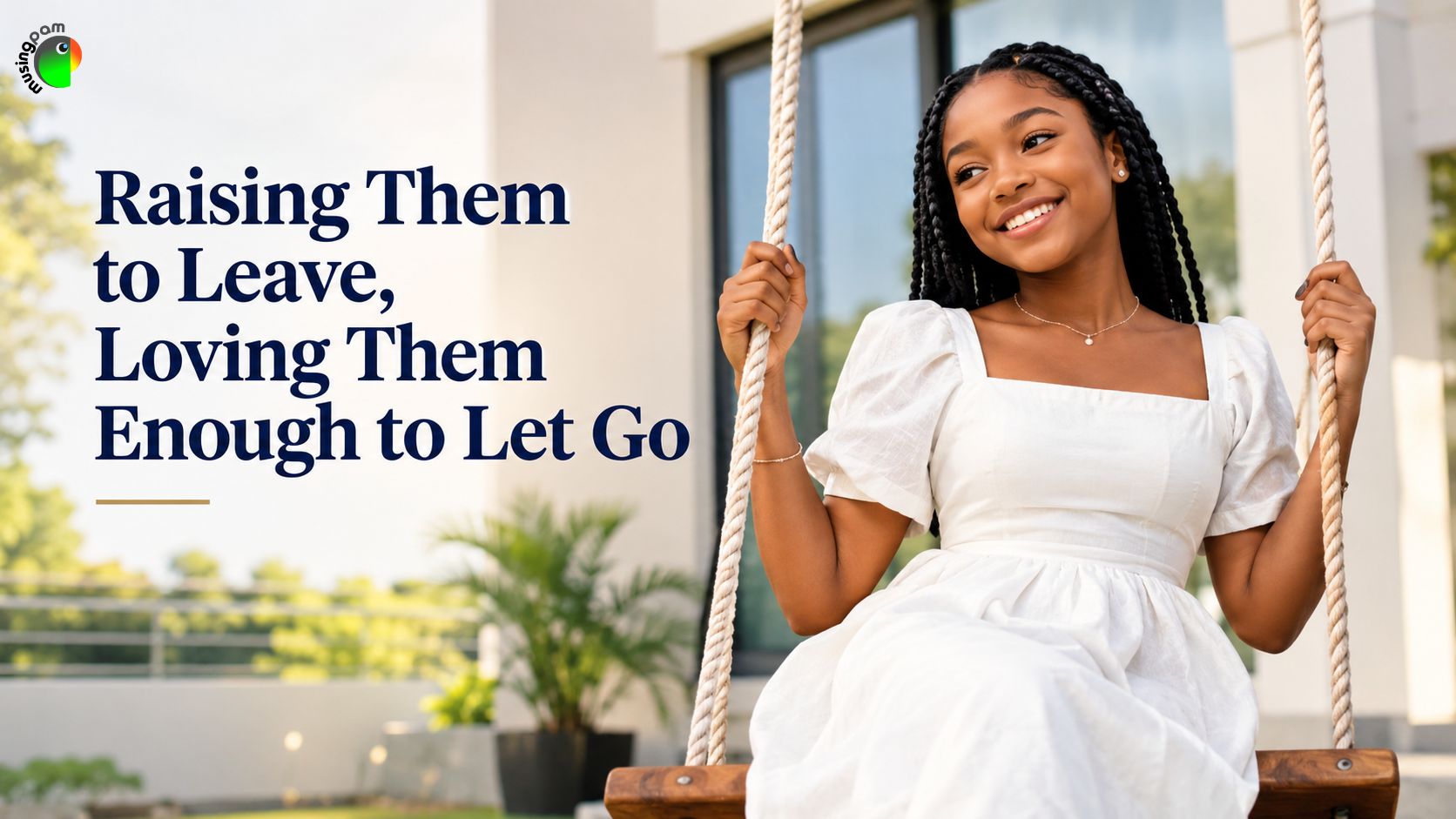
Raising Them to Leave, Loving Them Enough to Let Go
This year, my older daughter turns 16.
I have said that sentence a few times recently, and each time it seems to land a little differently. There is so much joy in it because I get to watch this beautiful young woman emerge before my eyes. I see her opinions becoming stronger, her confidence developing, her personality becoming more defined, and her understanding of herself growing.
There are moments when we are talking, and I find myself looking at her, thinking, When exactly did you become this grown? But alongside the joy, if I am honest, there is also worry. And maybe even a little fear.
Because sixteen feels dangerously close to eighteen. And eighteen feels dangerously close to leaving home.
In the blink of an eye, I will be celebrating her eighteenth birthday. We could be talking about university, accommodation, student finance, what she needs to pack and all the things I will inevitably insist she needs while she tells me she absolutely does not.
I can already imagine myself trying to squeeze one more thing into an already full car because, apparently, I will have convinced myself that her survival at university depends on an extra saucepan.

It sounds funny when I think about it now, but underneath the humour is something I don’t think we talk about enough as parents.
We spend so much of their childhood preparing them for independence, but nobody really tells us that we also have to prepare ourselves for what happens when they achieve it.
How Did We Get Here So Quickly?
There were years when eighteen felt impossibly far away.
When my children were little, life seemed to revolve around the next milestone. Sleeping through the night. Starting nursery. Starting school. Learning to read. Learning to swim. Losing teeth. Going on school trips. Becoming more independent.
We celebrated each step.
“Look, she can do it herself!”
And that was always the goal, wasn’t it?
We wanted them to become capable. Then something strange happens. They actually do.
The child who once needed you for almost everything gradually starts needing you for fewer things. They make their own breakfast. They organise themselves. They go out without you. They have conversations you know nothing about. They make decisions without asking your opinion first. They begin building a world outside the one you created for them.
And suddenly you find yourself wanting to whisper, Actually, can we slow this independence thing down a little? Because I don’t remember agreeing to the years moving this quickly.
Parenting Has Always Been About Letting Go
The more I think about it, the more I realise that parenting is really a long series of small goodbyes. We just don’t call them that.
- The first time they walk without holding your hand.
- The first day you leave them at school.
- The first sleepover.
- The first time they travel somewhere without you.
- The first time they don’t need you to solve a problem.
- The first time they say, “Mum, I’ve already sorted it.”
Each one is a tiny release. And perhaps that is why parenting can feel so bittersweet. We spend years teaching our children not to need us in the ways they once did, and then sometimes feel slightly wounded when they don’t.
But independence is not rejection. It is growth.

My daughter’s increasing independence does not mean my role is disappearing. It means my role is changing.
There was a time when I had to hold her hand to cross the road. Now my responsibility is to help her develop enough wisdom to navigate roads I may never walk with her.
That requires a very different kind of parenting.
Have I Taught Her Enough?
This is where the worry creeps in.
As eighteen begins to feel less like some distant age and more like an approaching reality, I find myself asking questions I didn’t ask before.
- Have I taught her enough?
- Does she understand money properly?
- Can she budget?
- Can she cook enough meals to survive without living entirely on noodles and takeaways?
- Does she know how to make appointments, ask questions, advocate for herself and speak up when something isn’t right?
- Would she know what to do if she felt unsafe?
- Would she recognise an unhealthy friendship or relationship?
- Does she know that she doesn’t have to stay anywhere that makes her uncomfortable just because she doesn’t want to appear rude?
- Does she understand that sometimes being responsible means making the unpopular decision?
- And, perhaps most importantly, does she know that she can always call me?
These are the things I think about now. Because preparing our children for independence is about far more than teaching them to cook, clean and use a washing machine.
Those things matter, of course. Nobody wants to send a child into adulthood believing clean clothes simply appear folded at the end of the bed.
But there are greater skills I want my daughters to carry with them.
- I want them to know how to make decisions.
- How to recover from mistakes.
- How to ask for help.
- How to recognise when something is not right.
- How to manage disappointment without believing their whole life is falling apart.
- How to say no.
- How to leave situations that compromise their values or wellbeing.
- How to be alone without feeling lonely.
- How to choose people who are good for them.
- And how to trust themselves.
Because one day I won’t be there to whisper the answer.
I Cannot Protect Her From Everything
This may be the hardest part for me. As parents, protecting our children becomes almost instinctive. When they are small, protection feels tangible. You hold their hand near the road. You check the temperature of their food. You make sure doors are locked. You know where they are, who they are with and what time they should be home.
But as they grow, protection becomes much more complicated.
There will be things I cannot protect my daughters from. There will be disappointment. There may be heartbreak. Friendships will change, and people will let them down. There will be mistakes I wish I could stop them from making and decisions I might have made differently.
And there will be moments when every part of me wants to step in and fix something. But sometimes loving our children means resisting the urge to rescue them from every uncomfortable experience.
If I solve every problem for them, how will they discover they can solve problems themselves?
If I remove every consequence, how will they learn responsibility? If I make every difficult decision, how will they learn to trust their own judgement?
That doesn’t mean withdrawing support. It means learning the difference between supporting and controlling. And I suspect that distinction becomes increasingly important as our children move towards adulthood.
I Don’t Want My Fear to Become Her Cage
This is something I am becoming increasingly aware of as my daughter grows.
My fears belong to me. They should not become hers.
The world can feel frightening when you are preparing to release someone you love into it. Suddenly you notice every danger. Every terrible story. Every possibility.
The temptation is to hold tighter. But I don’t want my desire to protect my daughters to accidentally teach them that the world is something to fear.
- I want them to be wise without being afraid to live.
- I want them to travel.
- To explore.
- To take opportunities.
- To meet people.
- To dream bigger than the boundaries of our home.
- To discover who they are when I am not standing beside them.
And perhaps that is one of the hardest expressions of parental love: raising someone with the confidence to walk away from the safety you created for them. Not because they don’t love home. But because home did its job.
Home Must Always Be Safe Enough to Return To
While I want my children to become independent, there is something else I desperately want them to know. Leaving home does not mean losing home.
I want them to know that this will always be somewhere they can return to. Not just when life is going brilliantly. Especially when it isn’t.
I want my daughters to know that if they make a mistake, they can call me. If their hearts are broken, they can come home. If university feels overwhelming, they can tell me.
If they have made a decision they regret, I would rather hear the truth than have them struggle alone because they are afraid of disappointing me.
That doesn’t mean there will never be accountability. Love and accountability can exist together. But I never want fear of my reaction to be the reason my child faces something difficult alone.
Maybe that is another part of preparing children to leave home: making sure they know the door behind them doesn’t suddenly lock.
But Who Prepares the Parent?
This is the part that catches me. While I am busy thinking about whether my daughter will be ready, I have started wondering whether I will be.
Because when she leaves, her life will change. But so will mine.
For years, parenting has shaped the rhythm of my days. School runs. Homework. Uniforms. Activities. Appointments. Conversations from another room. Reminders to tidy things that apparently nobody else can see are untidy. Waiting for them to come home. Asking where they are going. Asking when they will be back.
And then, one day, some of that will stop. There will be a bedroom that stays strangely tidy. Or perhaps, knowing teenagers, a bedroom that remains exactly as she left it.
There will be one less person shouting, “Mum!” from another part of the house.

One less plate at the dinner table. One less person whose movements I instinctively account for throughout my day. That will require an adjustment from me too.
Because letting go isn’t something that happens once, standing outside university accommodation trying not to cry.
It starts now.
It starts when I allow her to make age-appropriate decisions. When I let her handle something herself rather than immediately stepping in. When I accept that she may choose differently from me.
When I listen without always trying to fix. When I recognise that my job is slowly shifting from managing her life to becoming a trusted voice within it.
Maybe Being Needed Differently Is the Goal
I don’t think our children ever completely stop needing us. They just need us differently.
Perhaps one day my daughter won’t need me to remind her about appointments, organise things for her or check whether she has everything she needs.
But maybe she will call because she wants my opinion.
- Maybe she will ring after a difficult day because my voice still feels like home.
- Maybe she will ask me how to cook something she has eaten a hundred times in my house but somehow never thought to learn.
- Maybe she will call just to tell me something funny.
- Maybe she will come home, open the fridge, complain that there is nothing to eat despite there clearly being food, and for a moment it will feel as though nothing has changed.
I think that is what I hope for.
Not dependence. Connection.
I don’t want my children to remain close because they cannot cope without me. I want them to remain close because the relationship we built makes them want to.
Raising Them to Leave
So this year, as my daughter turns sixteen, I am choosing to see this stage differently. Yes, eighteen is getting closer. Yes, university may arrive before I feel ready.
Yes, there will probably be tears when that day comes, and I make absolutely no promises about maintaining composure when I eventually drive away.
But I also want to enjoy sixteen. I don’t want to spend these precious years mourning a goodbye that hasn’t happened yet.
There are still memories to make.
There are still conversations to have. There are still lessons to teach, arguments to navigate, laughter to share and probably several thousand reminders about things that should have been done already.
There is still time.
But I am becoming more intentional about what that time is preparing us for. I am raising my daughters to leave home one day.
Not because I want them to leave, but because I want them to be ready when life calls them forward. I want them to walk into adulthood knowing how deeply they are loved, but also knowing that they are capable.
I want them to know that home is a place they can return to, not somewhere they must remain because they are afraid to leave.
And perhaps that is the strange contradiction at the heart of parenting.
We hold them close enough to make them feel secure, while slowly loosening our grip enough for them to discover their own strength.
One day, the little hands we once held tightly will no longer reach for ours before crossing the road. They will be carrying keys to their own homes, making decisions about their own lives and creating families, friendships and worlds of their own.
And hopefully, when that day comes, we will realise that letting go was never really about losing them.
It was about loving them enough to prepare them for a life beyond us.
So yes, my daughter is turning sixteen, and my heart is feeling all of it: the pride, the joy, the worry and that quiet ache that comes from realising just how quickly childhood passes.
But maybe that ache is simply love learning a new shape. Because I am raising her to leave.
And, little by little, I am learning to let go